One stack to build the stack
The personal harness is over-built so client platforms stay thin. Memory, tools and skills live in the business and can change without the builder.
One stack to build the stack
The desk is fat on purpose.
An orchestrator that queues work and decides when a human has to look. A daily driver in Grok Build and the Grok CLI. Files that every session has to read before it is allowed to do real work. Secondary lanes that have to obey the same protocol.
That is not the product.
The product is the opposite of this desk. A platform a client can run when I am not in the room.
I am not going to pretend the Thursday skill folder is live. It is still a sketch. This note is about the inversion I already use, not a launch.
Layers, not a vendor list
People ask what I use. They want a list. Grok, Claude, Cursor, Codex.
The list is true - and useless. The thing that actually runs is an operating system with layers.
Sameth is the orchestrator. Queue, autonomy bounds, escalate to a person.
Grok Build plus the CLI is the daily driver: skills, plan mode, tool calls, subagent work.
Memory is files. Durable facts, dated logs, a folder for decisions. Every session, on every harness, is required to read them before it does substantive work.
Claude Code, Cursor and Codex are secondary lanes. They are not a second brain. They follow the same memory protocol and the same path policy, so switching lanes does not dump the context.
Above that sits an automation surface: scheduled jobs, connectors, research loops.
Under it sits project hygiene. Each active piece of work gets its own agents file, skills folder and memory workspace. Code stays local. Non-dev artefacts go to Drive.
I am not going to tour the folders. The names of the layers matter more than the paths.
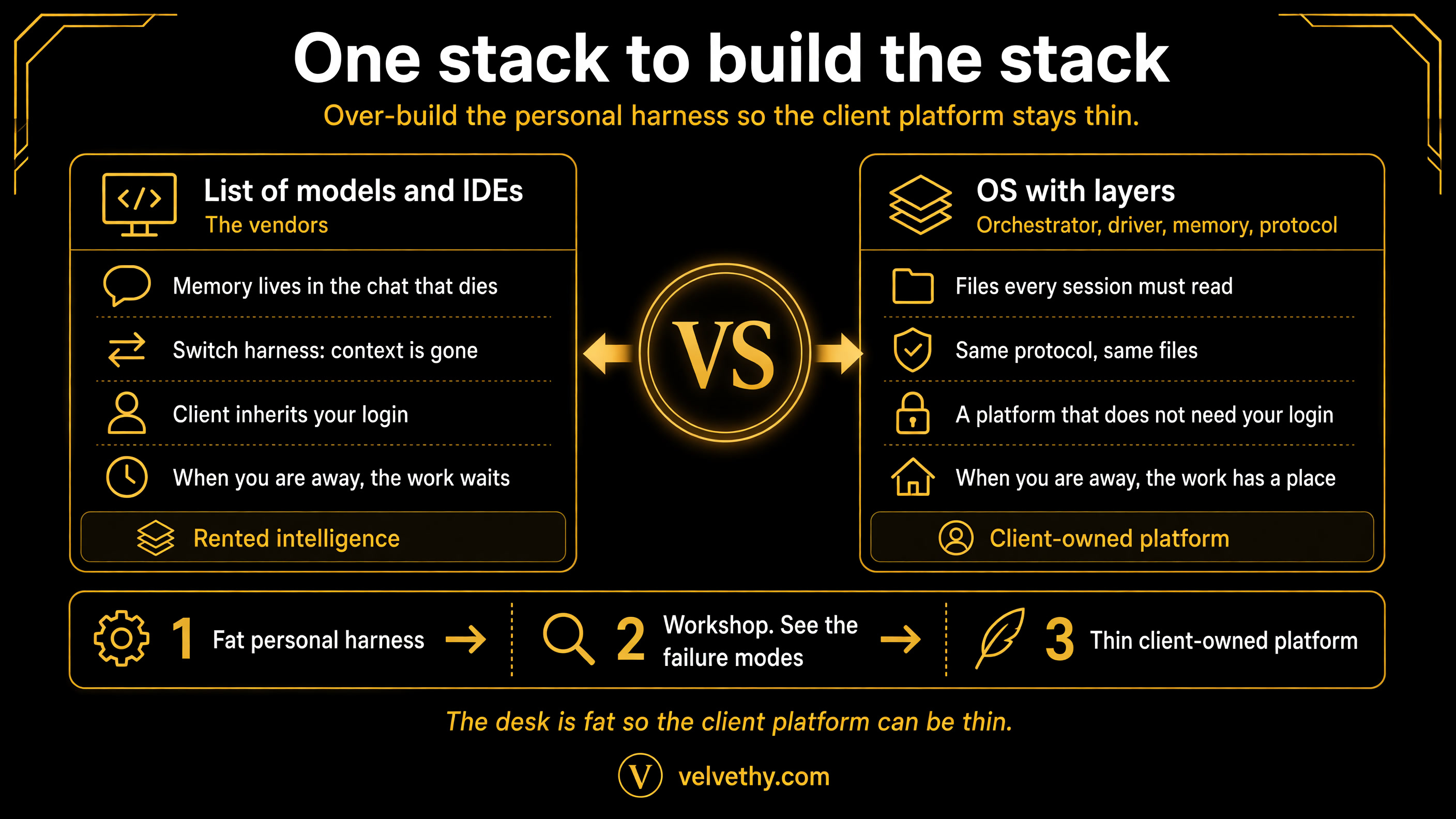
| List of models and IDEs | OS with layers | |
|---|---|---|
| What you name | The vendors | Orchestrator, daily driver, memory, protocol, automation, hygiene |
| Where memory lives | In the chat that dies | Files every session must read |
| When you switch harness | Context is gone | Same protocol, same files |
| What the client inherits | Your login, if you are kind | A platform that does not need your login |
| When you are away | The work waits | The work has a place to live |
The table is the distinction. A rented chat is not a layer. A layer is a job that still exists when the model name changes.
If you only have the list, you have a shopping receipt. If you have the layers, you can change a model and the job is still there.
That is the whole point of calling it an OS. Not branding. A place for work to live when the chat is gone.
The inversion
This whole personal system exists to design the opposite for clients.
On my side the harness is over-built. Too many files. Too many gates. Too much protocol for a job I already know how to do.
That is not a personality - it is a workshop.
I keep the fat stack so I can see the failure modes: a session that did not read memory, a skill that loaded because the file existed, a second harness that invented a new truth.
Those failures are cheap here. They are expensive in someone else’s company.
On their side the platform has to be under-dependent. Memory, tools, skills and knowledge live inside the business. They can change a skill without calling the original builder. They can change the model without changing the object.
The output of this stack is client-owned platforms, not more rented intelligence.
That is the inversion. I do not sell them my desk. I use the desk to leave them something that does not need my desk.
A thin client platform is not a small copy of my folders. It is a different shape. Their people own the files. Their people can change the skills. The builder is optional after the handoff, not the runtime.
If the platform still needs my login, the inversion failed - we built a nicer rental.
I would rather over-build the workshop and under-build the dependency. Fat on this side. Thin on theirs. Memory in the business, not in a chat I happen to keep open.
Structure is the leverage
Most of the leverage is not a model name. It is structure.
Mandatory memory reads. If the session did not open the file, it is not allowed to pretend it knows last month.
File continuity across harnesses, so Claude and Grok are not two companies with two histories.
A gate on sensitive skills: what is allowed to execute, and when. I already wrote the gate notes. This is the reason they exist in a personal OS. If I cannot run that discipline on my own work, I will not install a thinner version in someone else’s.
The Thursday folder is still a hole I have not owned. I will not ship a generated playbook into it. The overnight artefact is still the next receipt. The inversion does not wait for that folder. It is already how the rest of the stack is aimed.
Structure is boring to look at - that is a feature. A protocol does not need to look clever. It needs to survive a bad Tuesday, a new model, and a person who was not in the last meeting.
When the structure is missing, people compensate with more prompting. More prompting is not a layer. It is a habit. Habits do not transfer when the builder is away.
So the personal OS stays heavy. Reads, gates, path policy, hygiene per project - ugly on purpose. The client side should not inherit the ugliness. It should inherit the jobs: memory that lives in files, tools the business can change, skills that are not locked to one person.
What this is not
It is not just prompting. A prompt is a sentence. A layer is a place a sentence has to live.
It is not a single vendor. Grok is the daily driver. Other harnesses run because the protocol is shared, not because I collected logos.
It is not a replacement for judgement. It is a system that makes better judgement cheaper to apply, and harder to skip. The human still initials the miss.
It is not a live council of named personas. Sameth orchestrates. The public copy does not need a roster. Vanity bot-counts are not evidence.
It is not a remake of the last three notes. Those were the sentence at the top of a skill, the token on a call, and the owner-verifier-gate on an artefact. This one is the workshop those artefacts sit in, and why the workshop is fat.
It is also not a promise that the Thursday folder will be ready next week. A sketch is a sketch. I would rather say that plainly than dress a hole as a product.
Steal this
You do not need my daily driver. You need the inversion, and five names you can write on a card.
- Name the layers, not the vendors. Orchestrator, daily driver, memory, protocol, automation, hygiene. If you can only name models, you have a list.
- Make memory a file that every session must read before substantive work. A chat log is not memory. A chat log is a chat log.
- Put the same protocol on every harness. If switching tools dumps the context, you do not have a stack. You have hobbies.
- Put a gate on sensitive skills. Existence on disk is not permission. The last notes were the object. This note is why the object has to exist on the personal side first.
- Over-build your own harness so the client platform can be thin. If they still need your login in six months, you sold them rented intelligence. The output is a platform they own.
The personal OS is allowed to be ugly and heavy. The client platform is not. That is the whole point of owning a fat desk.
Field note from the build-in-public log. NDA-safe, no client names, rounded figures only. If this matches what you are seeing, get in touch.
§
BELOW THE LINE
PODČÁRNÍK · SIDEWAYS GLANCE, NOT A SUMMARY
On the colleague who takes the filing cabinet home
He has a briefcase that does not close. The filing cabinet lives in it. Tabs, copies, the one notebook nobody else is allowed to open.
When he leaves, the office is scenery. Desks, a plant, a notice board with last year’s map. The firm went in the boot.
Someone asks where the numbers are. He will bring them. He is already in the car.
Xerox onto the wall? That would mean the wall knows. The wall is not supposed to know. He is.
Holiday. The briefcase is by the sea. Here the drawers are empty and polite. We nod at the plant. We wait. The plant has no files.
I keep a fat desk so that does not happen on the other side of the door. He keeps a fat briefcase so that it does.
ČESKY. ORIGINAL PODČÁRNÍK
O kolegovi, který si odváží kartotéku
Má kufřík, který nejde zavřít. Kartotéka v něm bydlí. Záložky, kopie, jeden sešit, který nesmí otevřít nikdo jiný.
Když odejde, kancelář je kulisa. Stoly, kytka, nástěnka s loňskou mapou. Firma jela v kufru.
Někdo se zeptá, kde jsou čísla. Přiveze je. Už je v autě.
Vyxeroxovat na zeď? To by zeď věděla. Zeď nemá vědět. Ví on.
Dovolená. Kufřík je u moře. Tady jsou šuplíky prázdné a slušné. Kýveme na kytku. Čekáme. Kytka nemá spisy.
Já mám tlustý stůl, aby se tohle nedělo za dveřmi. On má tlustý kufřík, aby se to dělo.