Sidepromotion
Shared bots keep chats private and skills shared. The risk sits in between: one person's correction quietly becomes everyone's answer. Promote on purpose.
Sidepromotion
A colleague asks the shared bot for last quarter’s churn figure. It gives the number it has always given. She knows finance changed the definition in the spring, so she corrects it in her own chat, gets the right figure, says thanks and closes the tab.
The next morning a colleague two desks away asks the same question. He gets the new figure. Nobody told him the definition moved. Nobody could have told him, because nobody knows anything happened. The answer changed and the reason stayed in a private chat he cannot see.
Maybe the correction was right. Maybe it was right for her team and wrong for his. Either way, one person’s correction just became everyone’s answer, and the only trace is a different number.
That is the object of this note. Not the shared bot. Not the private chat. The path between them.
Two promises that do not fit
The occasion is SpaceXAI launching Team Bots for Grok on 28 September. I will name it once and then stay general, because the same pattern will show up in every shared assistant. Grok Bot is a product I use with real enthusiasm for hours every day. The shared Teams layer is the one part I have not tried, so this is about the pattern, not the product.
The launch post makes two promises. On the design: “The Bot keeps separate context and memories for each user while drawing on the skills shared across the team.” On their own data assistant, it “also remembers corrections to its queries, so what it learns from one person improves the answers it gives everyone.”
The first line builds a wall between people. The second puts a door in it. Both can be true, and I think the door is the useful part. The same post says an account bot “remembers the decisions teams make” and “becomes the system of record”.
A system of record that anyone can edit by chatting is not a record. It is a rumour with good uptime.
I call what happens at that door sidepromotion. A private correction becomes shared behaviour as a side effect of chatting, and nobody decided it should.
Three scopes, not two
Most discussion stops at private versus shared. There are three scopes, and they fail in different ways.
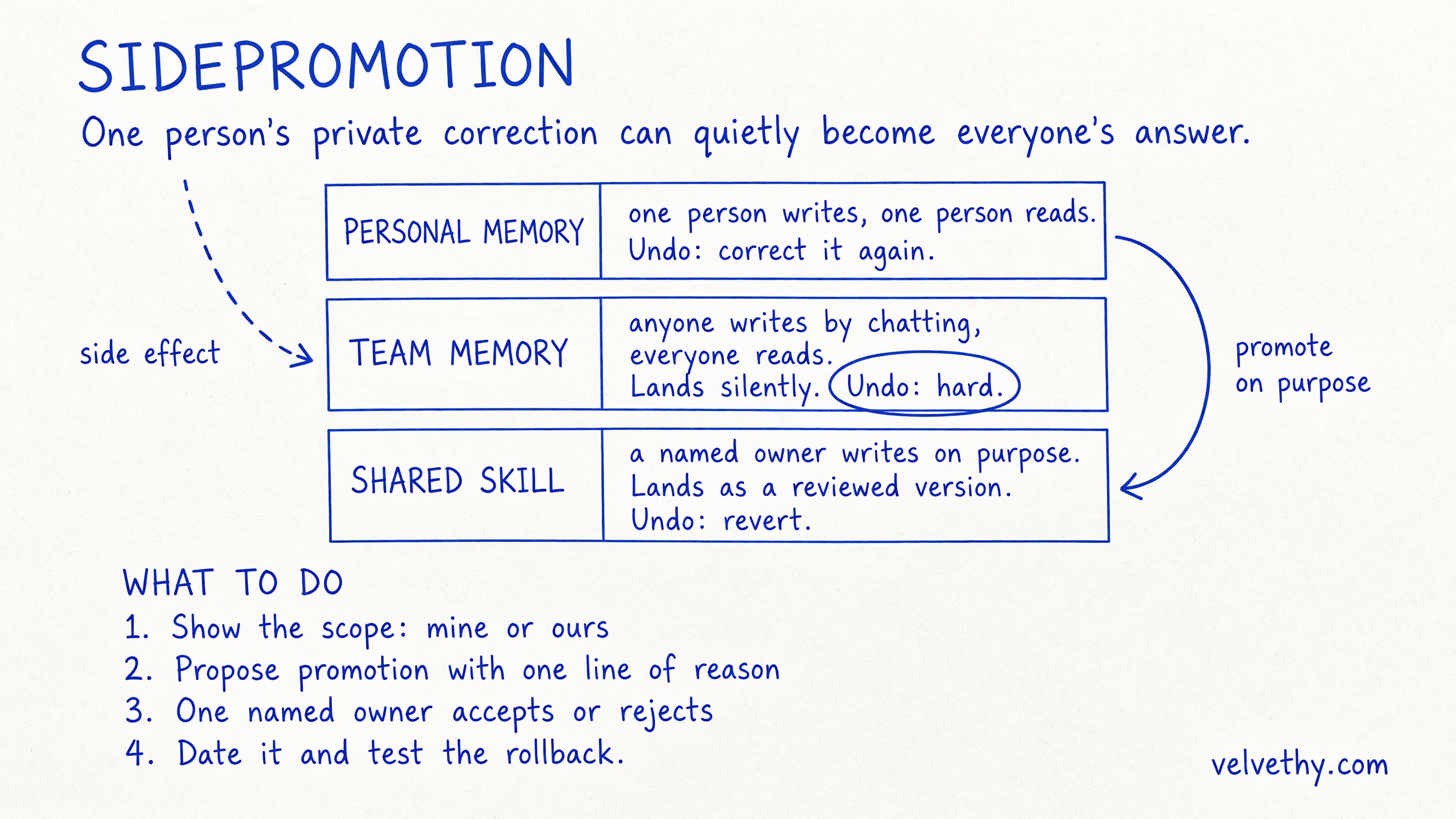
Personal memory is what the bot learns about one person. Their shortcuts, their definitions, the way they like an answer laid out. Team memory is what the bot learns that should apply to everyone working the role. A shared skill is the written procedure the whole role relies on. Which table to use, which chart format, what a finished answer needs.
| Scope | Who writes it | Who reads it | How a change lands | How you roll it back |
|---|---|---|---|---|
| Personal memory | One person, by chatting | That person only | Next time they ask | They correct it again or delete it |
| Team memory | Anyone on the role, usually by chatting | Everyone on the role | Silently, inside someone else’s answer | Hard, unless someone recorded what changed and why |
| Shared skill | A named owner, on purpose | Everyone on the role | As a reviewed version | Revert to the previous version |
Look at the middle row. Team memory has the readers of a shared skill and the write path of a personal memory. That mismatch is the whole risk.
The fix is not to ban team memory. It is to give it the last two columns of the bottom row.
When one person is enough
My own fleet keeps its memory in files I can read and diff. When I correct something, the correction lands in a file, and the next one to meet it is me. If it was wrong, I notice, because I remember making it.
Author, reviewer and reader are the same person. A lot of process collapses into habit, and that is fine. Nobody else pays for my mistakes in real time.
A second user of the same role changes the design. Now the person who meets the correction did not make it. The files would have to answer questions they never had to answer for me. Whose correction is this? Mine only, or ours? Since when? Who can take it back?
If the memory cannot answer those four questions, the second user is working from hearsay. Polite, fast, confident hearsay.
Promotion is a change, not a chat
If a correction should reach everyone, treat it like any other change to shared behaviour. Four steps, kept small.
Propose. The correction stays personal until someone suggests it for the team, with one line of reason attached.
Review. One named owner for the role accepts or rejects it. Not a channel vote.
Version. The promoted correction gets a date and an entry, so the next person can see what moved and when.
Roll back. The owner can undo it without guessing what else changed.
Who owns and checks a shared skill is the subject of Owner, verifier, gate. Team memory needs the same owner. It does not need a new ceremony.
Where a shared bot wins
A shared bot wins when several people work one role and corrections should build up. Account teams where people rotate on and off. Data questions where the same definitions come back every week. A support desk where the tenth person should not rediscover what the first one fixed.
There, shared learning is not a bug to switch off. It is the value. Sidepromotion is the cheap, accidental version of it. Deliberate promotion is the version you can defend when someone asks why the number changed.
Personal bots stay better for three things. Work only one person does, where there is nobody to share with. Private context that should never cross, like your own drafts and half-formed views. Fast experiments, where you want to try a correction for a day without asking anyone.
The mistake is choosing one bot type for everything. Experiment in the personal scope. Promote what survives into the team scope. Keep procedures in shared skills with an owner.
Steal this
- Show the scope of every memory when it is written, mine or ours. If your tool cannot show it, assume everything is ours and correct accordingly.
- Make promotion an explicit step. A correction stays personal until someone proposes it for the team, with one line of reason.
- Name one owner per shared role who accepts or rejects promotions. A person, not a channel.
- Date every promoted correction and keep a plain list of what changed. The next person should be able to see why the answer moved.
- Test rollback before you need it. Pick one promoted correction, undo it, and check that the answer really goes back.
Private chats are fine. Shared skills are fine. The gap between them is where a team’s answers drift. Put a door there, give it one key, and write down who used it.
Field note from the build-in-public log. NDA-safe, no client names, rounded figures only. If this matches what you are seeing, get in touch.
§
BELOW THE LINE
PODČÁRNÍK · SIDEWAYS GLANCE, NOT A SUMMARY
On the colleague who pressed so hard his correction reached the floor below
This week the shared assistants arrived, the kind that learn from one person and answer everyone. I read the announcement and thought of a man I used to know.
In the office before email, every letter went out as a stack. The top sheet for the customer, carbon paper, then copies for accounts, for the boss, and for the file nobody opened. You learned to press with the ballpoint the way you press a doorbell that has stopped working. Your fingertips stayed blue for days.
He was the careful one. When he found a wrong figure on his own copy, he did not bother anyone. He fixed it there, in pen, just for himself. He pressed like a man who had been right before.
The correction went through the carbon. Then through the next carbon. Then through the copy for accounts, the copy for the boss and the copy for the file. By lunch it had gone through the desk, the floor and one ceiling tile, and landed in the ledger of an accountant downstairs who had never seen the letter and now owned a new number.
Nobody asked why the number had changed. It was blue, it was neat, and it looked like it came from someone who knew. Downstairs they copied it into the quarterly figures. Upstairs he went to lunch feeling helpful.
A fortnight later the customer rang. The old number had been right. His number was right for his drawer and for nobody else’s. Every copy carried the same neat correction and not one carried a name, so the hunt for who changed it took a week and left a proper mess.
He slid a piece of cardboard under his own copy after that. It was the one procedure that building ever agreed on without a meeting.
The official presses just as hard today. The difference is that a shared assistant has no carbon to tear, no desk to bruise and no ceiling tile to slow the correction down. It goes straight through to accounts, in a calm and tidy voice, and the accountant does not doubt it, because nobody remembers whose pen it was. The man had a copy to slide the cardboard under. The assistant has only the answer everyone gets.
ČESKY. ORIGINÁL PODČÁRNÍKU
O kolegovi, který přitlačil tak, že jeho oprava propadla až do účtárny o patro níž
Tenhle týden dorazili sdílení asistenti, ti, co se učí od jednoho člověka a odpovídají všem. Přečetl jsem oznámení a vzpomněl jsem si na jednoho pána.
V podniku před mailama odcházel každý dopis jako štos. Nahoře originál pro zákazníka, pod ním kopírák, pak průklep pro účtárnu, pro šéfa a pro šanon, který nikdo neotvíral. Propiskou se tlačilo jako na zvonek, co už nezvoní. Prsty jste měli modré ještě několik dní.
On byl ten pečlivý. Když na svém průklepu našel špatné číslo, nikoho neotravoval. Opravil si ho sám, perem, jen pro sebe. Přitlačil jako člověk, který už párkrát pravdu měl.
Oprava prošla kopírákem. Pak dalším kopírákem. Pak průklepem pro účtárnu, pro šéfa i pro šanon. Do oběda prošla stolem, podlahou a jednou kazetou podhledu a přistála v knize účetní o patro níž, která ten dopis nikdy neviděla a najednou měla nové číslo.
Nikdo se nezeptal, proč se číslo změnilo. Bylo modré, úhledné a vypadalo jako od někoho, kdo ví. Dole ho přepsali do čtvrtletní uzávěrky. Nahoře šel na oběd s pocitem, že pomohl.
Za čtrnáct dní volal zákazník. Staré číslo bylo správně. To jeho platilo pro jeho šuplík a pro nikoho jiného. Na každém průklepu byla stejná úhledná oprava a na žádném jméno, takže hledání, kdo to změnil, trvalo týden a byl z toho pořádný bordel.
Od té doby si pod svůj průklep podkládá kus kartonu. Je to jediný postup, na kterém se ta budova kdy shodla bez porady.
Úředník tlačí stejně i dnes. Rozdíl je v tom, že sdílený asistent nemá kopírák, který by se protrhl, stůl, který by se promáčkl, ani kazetu podhledu, která by opravu zpomalila. Propadne rovnou do účtárny, klidným a úhledným hlasem, a účetní o ní nepochybuje, protože nikdo neví, čí bylo to pero. Ten pán měl průklep, pod který mohl podložit karton. Asistent má jen odpověď, kterou dostanou všichni.